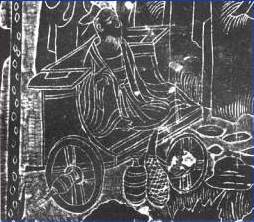
China's Wheeled Chair
One of the earliest depictions of a wheeled chair appears on a Chinese stone slab. Wheeled platforms for mobility were noted across Chinese texts of this era, predating European designs by centuries.
From ancient wheeled thrones to today's high-tech power chairs, discover how wheelchair design evolved alongside medicine, engineering, and the disability rights movement.
One of the earliest depictions of a wheeled chair appears on a Chinese stone slab. Wheeled platforms for mobility were noted across Chinese texts of this era, predating European designs by centuries.

King Philip II of Spain, suffering from gout, used a specially designed chair fitted with wheels, armrests, and a leg rest — one of the first documented European wheelchair-like devices built for a specific individual.
German watchmaker Stephan Farffler, paraplegic from age three, built a three-wheeled hand-cranked chair. It is widely regarded as the first self-propelling wheelchair — a remarkable feat of personal engineering.
John Dawson of Bath, England, designed the "Bath Chair" — a three-wheeled, hooded chair for invalids pushed by an attendant. It became fashionable across Europe and spread wheelchair use among the wealthy.

The first US patent for a wheelchair was filed, describing a chair with small front wheels and large rear wheels — a layout still recognisable today. Innovation accelerated as industrialisation made manufacturing cheaper.

World War I created an enormous demand for rehabilitation equipment. Steel-framed wheelchairs replaced wood, and veterans' hospitals drove rapid improvements in durability, adjustability, and standardised manufacturing.

Herbert Everest and Harry Jennings — the former a wheelchair user himself — patented the first lightweight, foldable, tubular steel wheelchair. Their design dominated the market for decades and became the global template.
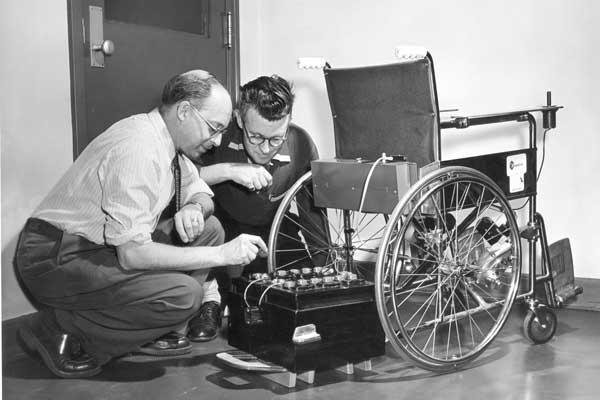
Canadian engineer George Klein developed the first electric wheelchair for veterans with spinal cord injuries. Bulky by today's standards, it laid the foundation for all modern power chairs, transforming independence for people without upper-body strength.

Inspired by the civil rights movement, disability activists in the US began demanding accessible public spaces, transport, and housing. Ed Roberts at Berkeley became a leading figure, using a motorised wheelchair and advocating for independent living.
The first wheelchair marathon entrants appeared in Boston. Ultra-light, angled racing chairs began to be purpose-designed for athletics. The 1976 Paralympics in Toronto cemented wheelchair sport as a serious competitive discipline worldwide.

President George H.W. Bush signed the ADA into law — a landmark civil rights act prohibiting discrimination and requiring accessible public accommodation, transportation, and employment. It transformed built environments globally.
Aluminium alloys and titanium frames brought manual wheelchairs under 10 kg. Rigid frames improved propulsion efficiency dramatically. Carbon-fibre composites followed, making high-performance chairs lighter than a typical laptop.

Dean Kamen (inventor of the Segway) introduced the iBot — a gyroscope-stabilised power wheelchair that could climb stairs, traverse rough terrain, and raise users to standing eye level. It was a technological leap that inspired future designs.
The United Nations adopted the Convention on the Rights of Persons with Disabilities (CRPD) — the first comprehensive human rights treaty of the 21st century specifically addressing disability, signed by 164 countries.

Researchers developed wheelchairs controlled by eye-tracking, voice commands, and brain-computer interfaces (BCI), enabling use by people with severe paralysis. Obstacle-avoidance AI and autonomous navigation entered the prototype stage.

The Rio 2016 Paralympics showcased wheelchair athletes at the highest level of human performance. Racing chairs reached speeds over 40 km/h, and wheelchair basketball drew global audiences. Adaptive sport culture shifted mainstream perceptions of disability.

Commercially available standing power wheelchairs allow users to raise themselves to standing height, improving health outcomes and social interaction. Wearable robotic exoskeletons now complement wheelchair use, blurring the boundaries of assistive technology.

AI-powered autonomous wheelchairs, modular 3D-printed frames, neural-interface controls, and universal design principles are reshaping mobility. The goal: a world where no one is excluded by the limitations of either their body or their environment.